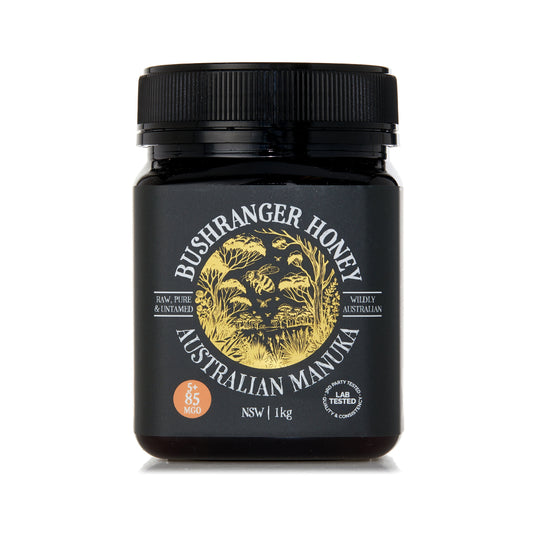
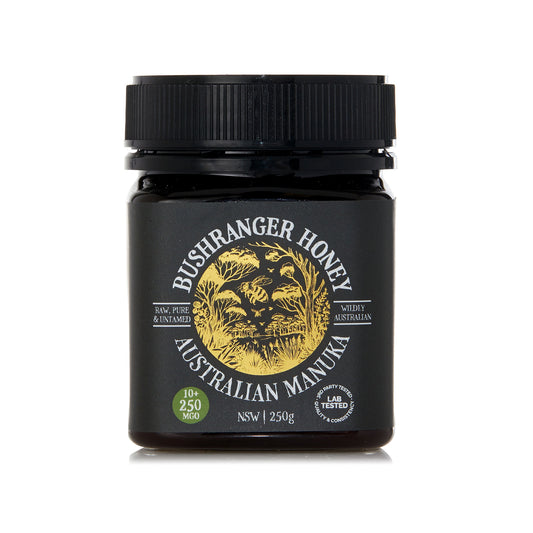
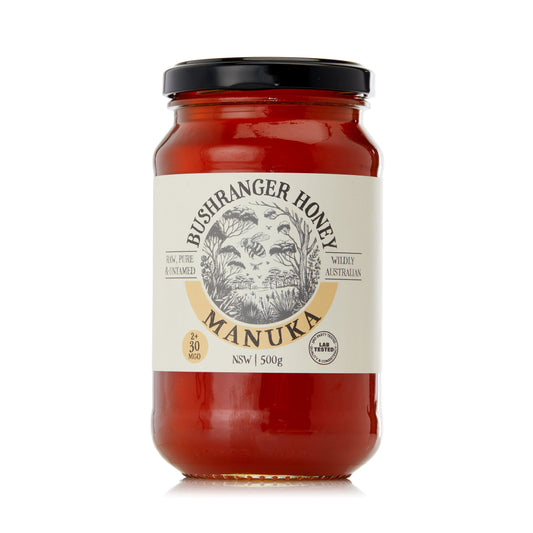
Why Australian 50+ 2250MGO Manuka Honey is so rare and expensive (Complete Guide)
If you’ve been lucky enough to come across a 50+ 2250MGO Manuka honey, you would know it isn’t an easy honey to come by— this is no ordinary honey.
The rarest of rare, an ultra potent and therapeutic tier of grading— here at Bushranger Honey we have ethically harvested some sensational Manukas including the 50+ 2250MGO from Far North Queensland and have learnt some things along the way.
So why is 50+ 2250MGO Manuka Honey so rare?
Let’s break down the science, scarcity, and value behind the liquid gold.
What does 2250MGO mean?
MGO is a quality rating used to quantify and indicate the strength and therapeutic properties of Manuka honey. Manuka honey is derived from the nectar of the Leptospermum scoparium (commonly referred to as the Manuka tree). That nectar naturally contains high amounts of the compound Methylglyoxal (MGO), which is essential to Manuka honey’s unique properties. Methylglyoxal (MGO) is famous for:
- Antibacterial properties
- Anti-inflammatory support
-Prebiotic activity
- Wound-healing benefits
The MGO number indicates the actual amount of methylglyoxal in the honey. It is deemed to be among the most credible and transparent ways to educate your customer about the honey’s potency and quality.
What Does 2250 MGO Represent?
A 2250 MGO rating indicates 2250 mg of methylglyoxal per kilogram of honey.
For Comparison:
- Regular honey: Negligible MGO
- Standard Manuka: 100–300 MGO
- High-grade therapeutic: 750–1400 MGO
- Premium Reserve: 2250 MGO
The higher the MGO rating:
- The greater the antibacterial potency
- The more concentrated the therapeutic properties
- The rarer and more difficult the honey is to produce
2250 MGO represents an ultra-premium product for people looking for both purity and strength—an ultra-high potency Manuka honey.
Why 2250 MGO Australian Manuka Honey Is So Rare.
From the Native Australian Leptospermum Species. Australian Manuka honey is produced when bees pollinate native Leptospermum species that grow on Australia’s coastlines and bushlands.
These plants:
- Bloom for just a couple of weeks at most.
- Are highly weather dependent.
- Grow in rugged, sometimes remote areas.
- Produce nectar that varies greatly according to the region. Not every Leptospermum species — or every season — produces nectar high in MGO. 2250 MGO takes an exceptional natural environment.
Ultra-High MGO Forms Naturally (But Extremely Rarely).
MGO emerges from DHA present in the nectar.
For Australian Manuka honey to reach 2250 MGO:
-The high concentrations of DHA in the nectar must be high.
-Under controlled conditions, the honey needs to have matured.
-Temperature and storage should allow for natural conversion.
-The batch has to test at or above 2250 — not 2000, not 2100. The harvest itself is only a fraction of that. The rarity alone will greatly increase its value.
Strict Australian Testing Standards.
High-Grade Australian Manuka Honey Is Assessed in Independent Laboratory Testing for Confirmation:
-MGO concentration.
-Antibacterial activity.
-Purity and authenticity.
-Absence of contaminants.
Why 2250 MGO Australian Manuka Honey Is So Expensive.
Manuka honey at this grading is incredibly scarce, it occurs very rarely and only under perfect conditions at the hands of expert beekeepers who have a deep understanding and connection to the land.
Very high Antibacterial Potency. This Australian Manuka honey is also ultra-concentrated at 2250 MGO. This level is often sought after by consumers for:
-Immune support.
-Wound and skin applications.
- Digestive support.
-Targeted antibacterial application. More potency = Higher perceived function value.
Remote Production Costs.
A great number of Australian Leptospermum plants grow in isolated bushland. Beekeepers must, for example:
-Transport hives to remote sections.
-Check the short flowering windows.
-Handle erratic weather conditions. Costs of production are much higher than for regular honey harvesting.
-Spend decades finding the site locations in the bush where the bees will yield high graded honey.
Supply limited; demand growing
Awareness of Australian Manuka honey is growing globally very quickly. But:
- Only a small percentage exceeds 2250 MGO.
-Harvest is seasonal.
-Mass-production is impossible on high grades. Basic economics applies:
Extremely limited supply + Rising global demand = Premium pricing.
Positioned as Ultra-Premium. 2250 MGO Australian Manuka Honey features top of the grading scale. It’s often:
-Bought as a therapeutic-grade product.
-Gifted as a luxury wellness item.
- Used in small, targeted amounts.
It isn't that it's any product; instead it represents pure, concentrated functional honey.